


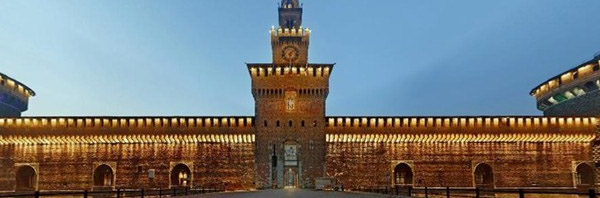
Castello Sforzesco
Il Castello Sforzesco è stato per secoli il simbolo del potere esercitato dai Signori di Milano e dai dominatori stranieri. Solo nel Novecento ha assunto l’aspetto di un luogo di cultura. Il suo nome riporta al XV secolo, all’epoca di Francesco Sforza, che lo volle ricostruire a partire dal 1450, ma l’origine del Castello è più antica: sorse infatti per volere di Galeazzo II Visconti nella seconda metà del Trecento.
In seguito all’Unità d’Italia (1861) e all’acquisto del complesso da parte della città di Milano, si apre la fase del restauro e della ricostruzione, che vede protagonista l’architetto Luca Beltrami. Nel 1905 viene inaugurata la Torre del Filarete, completamente riedificata. Il Castello è così restituito alla città e destinato ad accogliere musei e biblioteche, assumendo la funzione culturale e pubblica che ancora oggi lo caratterizza.
Il Castello si compone di diverse sezioni: l’Edificio monumentale, il Piano terreno della Corte Ducale col museo d’Arte Antica, il Piano primo della Corte Ducale con la raccolta dei mobili e la pinacoteca, il Primo e secondo piano della Rocchetta con le raccolte d’Arte Applicata e il museo degli strumenti musicali, il Sotterraneo della Rocchetta e la Sala Viscontea col Museo della Preistoria e il Museo Egizio, le Merlate, il Rivellino e la Stanza delle Guardie.









Sforzesco Castle
Sforzesco Castle was for centuries the symbol of power exercised by the Lords of Milan and by foreign rulers. Only in the 20th century took the appearance of a place of culture. His name back to 15th century, at the time of Francesco Sforza, who wanted to rebuild from 1450, but the origin of the castle is older: It was commissioned by Galeazzo II Visconti in the second half of the fourteenth century.
Following the unification of Italy (1861) and the purchase of the complex by the city of Milan, Opens the phase of restoration and reconstruction, in which the protagonist architect Luca Beltrami. In 1905 opened the Torre del Filarete, completely rebuilt. The castle was thus returned to the city and intended to house museums and libraries, assuming the cultural and public function that still characterizes.
The Castle consists of several sections: the monumental building, the ground floor of the Ducal Court with the museo d’Arte Antica, the first floor of the Ducal Court with the collection of furniture and art gallery, the first and second floor of the Rocchetta with collections of applied arts and the Museum of musical instruments, the Underground della Rocchetta and the Viscontea Hall with prehistoric Museum and the Egyptian Museum, the Embattled, the ravelin and the room of the guards.